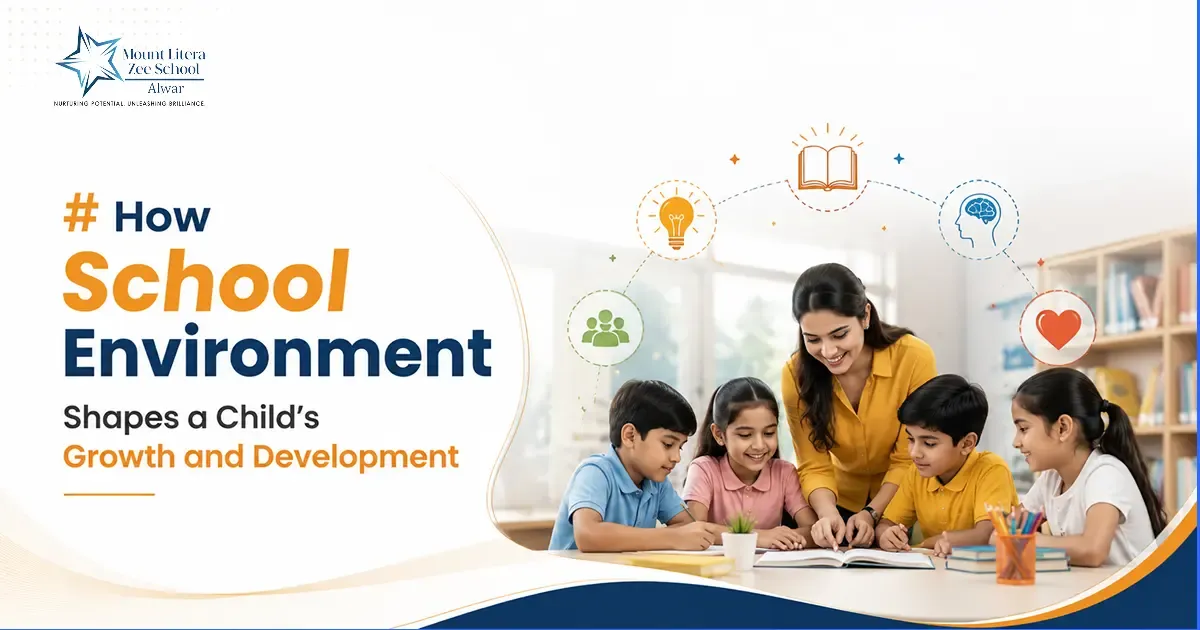
How School Environment Shapes a Child’s Growth and Development
On this page
Schools are normally seen as institutions where students attend to study various subjects and take exams. However, the truth behind what a good school actually does to benefit a child goes much beyond this.
The impact of schools on child development goes far beyond any aspect related to the nature of the child’s growth, including how he or she thinks, behaves, copes with problems, relates to other people, and believes he or she is able to do. This blog aims to look into the role of schools for students from an academic and personal point of view.
Why Does the School Environment Matter for Child Development?
The process of learning for a child depends on a lot of factors aside from what he studies and the classroom. The learning environment has a huge impact on the way a child thinks and feels.
Right from the teacher-student relationship to the environment in which the learning process takes place influences the development of the child. A good environment creates confidence in the child and promotes learning. A bad environment may affect the concentration and creativity of the child.
Education of children is often talked about in the context of their economic value and qualifications to work and earn a living. This is indeed one important aspect of the value of schooling. However, this is not all there is to it.
How Does the School Environment Influence a Child’s Growth?
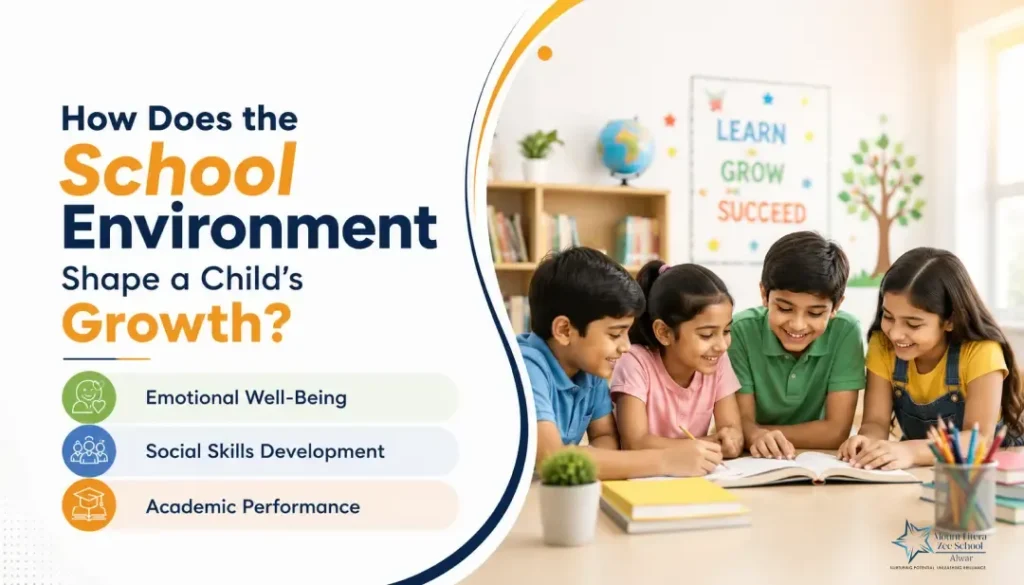
Mostly children spend the major part of their time in school in Alwar. The experience they receive will shape their attitudes towards learning or influence their personality.
A strong school always makes the learning environment the best school culture, which will also encourage students to learn.
- Ask questions freely
- Explore their interests
- Build healthy relationships
- Participate confidently
The children are more motivated to learn when they feel emotionally secure. They are very excited to be part of the classroom actively and put forth their ideas. The students who are learning in a conducive atmosphere do not fear thinking independently.
Emotional Well-Being
It is very likely that a child who has security and self-worth will be stronger and capable of dealing with any problems they encounter. This will be achieved by creating such a state so that the child can become relaxed and have stability, which is very important especially at an early age.
Social Skills Development
Children learn how to engage with people at a pre-primary school in Alwar. A nurturing atmosphere promotes the following:
- Empathy & Understanding
- Effective Communication
- Teamwork & Collaboration
These abilities are crucial for life outside of the classroom as well as for education.
Academic Performance
The presence of an organized environment helps students focus and become engaged in learning. When students feel at ease in the best senior secondary school in Alwar, they are more likely to be focused, accomplish their goals, and learn.
What is the Role of Teachers in Supporting Children’s Development
Teachers are an integral part of shaping the school environment positively in the English medium school in Alwar. The way they communicate, how they manage the classroom, and their attitude towards students affect students for a long time to come.
The important things by teachers for students:
- Encourage participation and curiosity
- Adapt to different learning styles and needs
- Foster respectful and inclusive classrooms
Equally important is the fact that school leaders set a tone by defining values and having a coherent culture in the process. In case all of that comes together, it leads to an inspiring environment for students.

Why Social Interaction Matters for a Child’s Growth
Social interaction is important in the development of confidence and social skills in a child. Furthermore, social interaction will make a child learn how to behave in society.
Communication Skills Development
Interaction with others develops in children a large vocabulary, the ability to formulate thoughts, and the skill of communication for child development in Alwar schools. Moreover, it helps to get rid of complexes and shyness and develop a sense of the world and an understanding of society.
Emotional Intelligence
Interacting with other people and, more precisely, playing contributes to the development of children’s awareness of the community and belonging along with emotional intelligence. Besides, through interactions, they learn how to cope with their emotions and how to find solutions for any problem, as well as to understand the perspectives of others.
Encourage Teamwork
Teamwork is based on interaction and helps to find a common language, share responsibilities, and develop critical thinking, as well as the ability to realize oneself in society by a supportive school environment in Alwar. Moreover, work in teams helps to develop and reinforce positive aspects of personality, confidence in one’s actions, and respect for others.
Self-Confidence
Children learn to stand up for themselves and express their views through socialization, as well as to meet people who think in the same way and thus to make friends. Also, the communication skills they develop help them feel more secure in a new environment.
Empathy & Teacher Respect
Communication builds up empathy and tolerance along with treating others the way they like to be treated. Additionally, communication with various people allows one to reach an understanding and help each other out.
Problem-Solving Skills
Interaction naturally implies the inevitability of problems, disagreements, and conflicts, which, fortunately, teach children to yield, come to terms, and respect each other’s opinions, points of view, and ways of solving specific situations, as well as to learn how to solve problems.
How Activities and Play Support Holistic Development
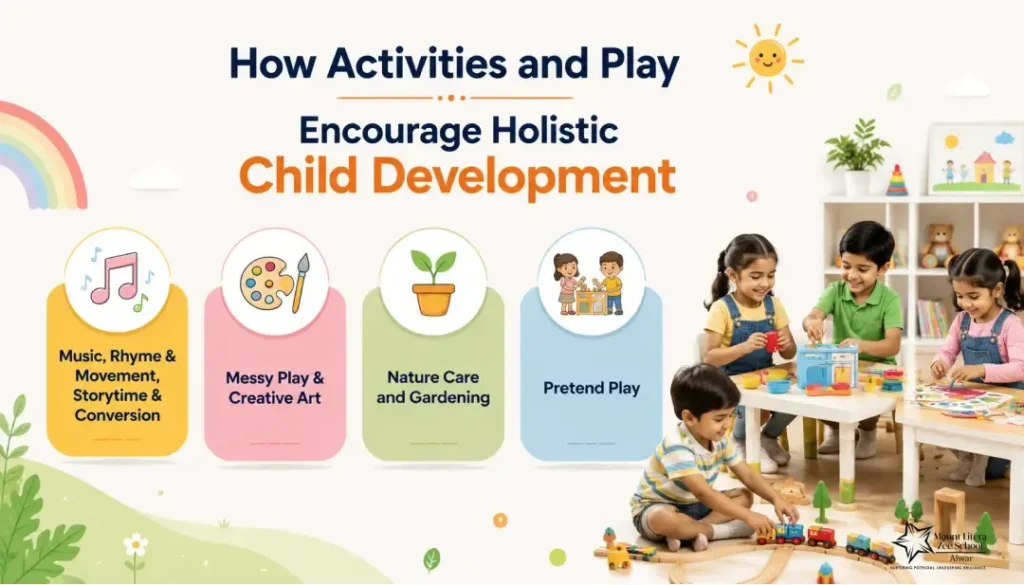
Here are some activities and play that will support holistic development in students:
Music, Rhyme & Movement
There are many ways of ensuring memorization, listening, and coordination abilities, and action songs is one. It is quite common for young children to engage in musical activities without being ready to speak out in a group context.
The power of music lies in its capacity to communicate with a lot of learners at once. Within minutes, a child may be engaged in mimicking movements, following directions, clapping to the rhythm, and interacting with other children. It is easy but so much learning happens!
Storytime & Conversion
Loud reading helps vocabulary, listening, and imagination. Equally important, it allows for creating a comfortable joint experience during which children learn to concentrate, ask questions, and relate stories to their own experience.
The talks are just as important as actually reading the story. Each time the grown-ups stop for a while to imagine how the character feels and what may happen further, kids learn how to feel empathy and think ahead. It is an excellent exercise that builds several skills at once.
Messy Play & Creative Art
They do more than just keep them entertained with their little hands. They will help the children develop fine motor skills, explore new textures, make decisions, and even express emotions that they might be unable to express through words while at school. Since messy activities always involve extra clean-up, they tend to frustrate adults, but they really have some advantages after all.
Nature Care and Gardening
The planting of seeds, watering of herbs, and observing the growth processes will instill in children a sense of responsibility and wonder for child growth and development. Gardening exposes children to science concepts at an early age in an extremely practical way, but it can also be used as a tool for instilling calmness and nurturing in children.
Pretend Play
Role-playing through home corners, dressing-up games, stuffed toys, and other similar activities helps create an environment that provides security to the children for exploring the world around them through their imagination. By using dramatic play, children explore language as well as their environment.
It can also help us identify what the child processes emotionally. In doing so, a child who pretends to be a doctor or a teacher is not only playing but also exploring his social relationship and self-confidence.
Why Choose MLZS for Child Development and A Supportive Learning Environment?
A positive learning environment makes it possible for kids to acquire knowledge, socialize, and emotionally grow while building up their spirit of curiosity, creativity, and self-assurance. A holistic educational approach enables kids to fully realize their potential.
The best school for my kid would be one where every child can unlock his potential and excel both academically and creatively and confidently.
Holistic Child Development
Developing children in the academic, creative, communicative, emotional, physical and social domains is best achieved through a balanced approach.
Supportive Learning Environment
A positive environment allows children to express themselves, ask questions, become involved, and explore new things, while being supported and guided by qualified and caring educators.
Experienced and Caring Educators
Trained teachers will be able to make sure that every single child is getting adequate attention and motivating him/her to participate actively in class, identifying his/her own requirements and helping him/her overcome obstacles individually.
Activities Outside the Curriculum
Sports, creativity, group or individual games, and cultural programs enable children to discover their interest areas, become socially adept, build their self-confidence, and learn new things in the school environment.
Final Thoughts
The importance of the school environment is surely great. School is not only a place for education but also a second home where a child is helped to realize his or her abilities in life development in Alwar. The right environment, which is inspiring, encouraging, and motivating, is the factor that will help the child develop his/her potential.
Investing in the creation of the right school environment is investing in the future success and happiness of the child and creating the background for strong character development.
Frequently Asked Questions
1 Why is the school environment important for children?
Students’ emotions, behavior, and learning are all impacted. While a bad atmosphere might cause stress or disengagement, a supportive one can enhance focus, confidence, and involvement.
2 What are the key features of a good school environment?
A warm and comfortable environment, encouraging instructors, an inclusive culture, stimulating classes, and chances for students to express themselves are all crucial components.
3 How does a positive school environment improve learning?
Students are more likely to participate, ask questions, and maintain their motivation when they feel comfortable and supported. Stronger academic results and improved comprehension follow from this.
4 How can parents examine a school environment?
During visits, parents can see student behavior, classroom interactions, and the general atmosphere. Inquiring about instructional methods and welfare support can also yield valuable information.
Written by
Rajan Jhiriwal
Mount Litera Zee School, Alwar — sharing guidance for parents and students.