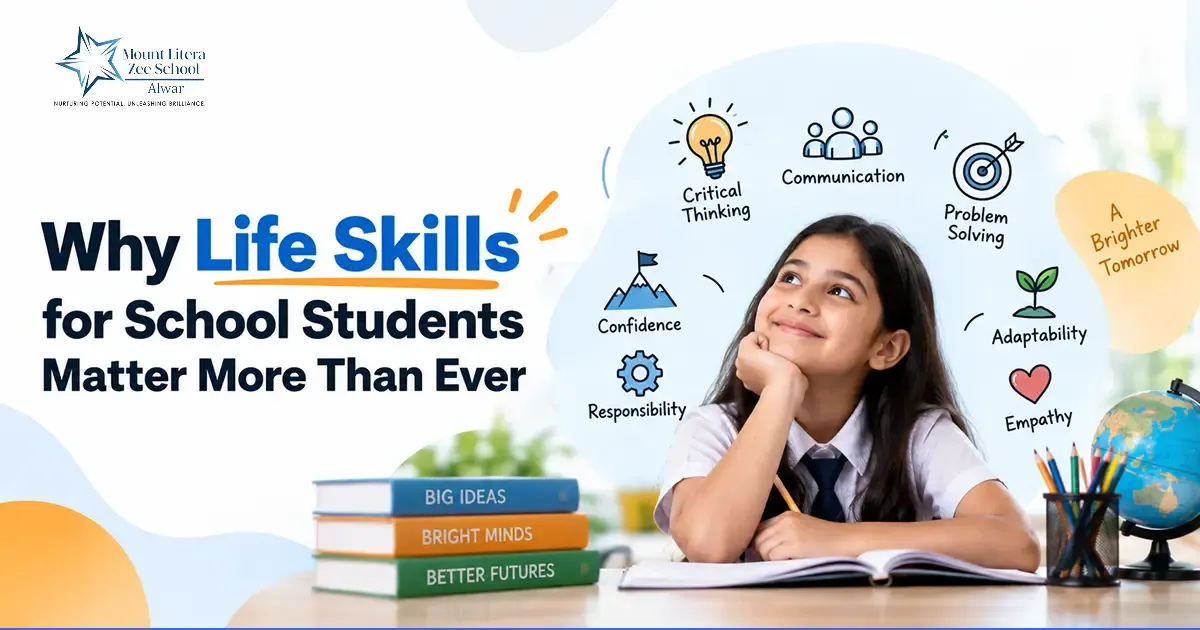
Why Life Skills for School Students Matter More Than Ever
On this page
Every parent has seen some version of this. A child who scores beautifully in a science test goes quiet when asked to present three lines in front of the class. A student who solves tricky maths problems can’t decide how to spend two hundred rupees of pocket money without regretting it. A topper is low for a week after losing an inter-house match — not because of the loss itself, but because no one ever showed them how to sit with disappointment and get back up.
Marks tell us what a child knows. They say very little about whether a child can speak up, work with others, bounce back, or make a sensible choice when no one is watching. And those are exactly the moments that fill an adult life.
So here’s a question worth sitting with: beyond the report card, what does your child actually need to do well in the real world? For a growing number of teachers and parents, the honest answer points one way — life skills for school students are no longer a nice extra. They are part of the core.
What Do We Actually Mean by “Life Skills”?
Let me keep the definition simple, then we can move past the textbook version.
The World Health Organization describes life skills as “abilities for adaptive and positive behaviour that enable individuals to deal effectively with the demands and challenges of everyday life.” In plainer words: life skills are what help a child handle whatever the day throws at them — a disagreement, a decision, a deadline, a difficult feeling.
The WHO groups the most important ones into ten core life skills, usually taught in five pairs:
- Decision-making and problem-solving
- Creative thinking and critical thinking
- Communication and interpersonal skills
- Self-awareness and empathy
- Coping with emotions and coping with stress
You’ll notice none of these appear on a marksheet. Yet each one quietly shapes how a child experiences school, friendship, and eventually work.
Why Life Skills Matter More Than Ever for Today’s Students
Children today are growing up in a world that changes faster than any syllabus can keep up with. They will use tools that haven’t been invented yet and enter jobs that don’t have names right now. Information reaches them constantly — some useful, much of it not — and they are expected to make sense of all of it, often on a screen, often alone.
Academic knowledge helps them understand the world. Life skills help them navigate it.
This isn’t a fringe idea. India’s National Education Policy 2020 states plainly that “the aim of education will not only be cognitive development, but also building character and creating holistic and well-rounded individuals equipped with the key 21st century skills,” and it lists “life skills such as communication, cooperation, teamwork, and resilience” among its guiding principles. The CBSE has gone further and made life skills education a formal part of school learning for Classes VI to X. Globally, agencies like UNICEF frame these transferable skills as essential for children as they move from childhood to adulthood and from education to work.
The message from every serious source is the same. A child who can only reproduce answers is not fully prepared. A child who can also think, adapt and relate to people is.
The Life Skills That Make the Biggest Difference
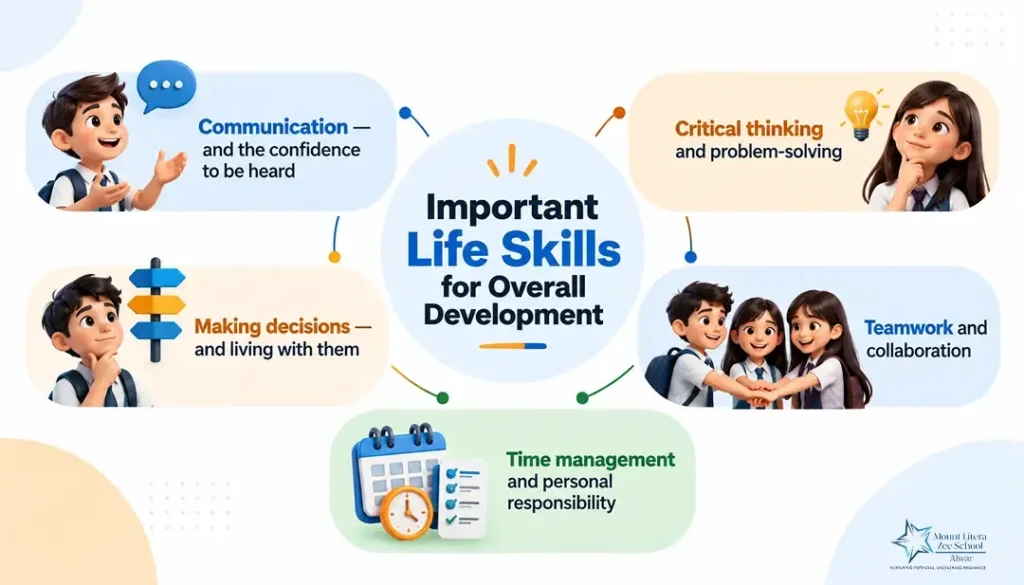
One could list dozens of skills. These are the ones that show up again and again in a child’s real day.
Communication — and the confidence to be heard
A child can know the right answer and still lose the argument, the friendship or the opportunity, simply because they couldn’t express it. Communication is speaking clearly, yes — but also listening, reading a room, and disagreeing without wounding. It grows every time a child asks a question in class, settles a quarrel with a friend, or explains a project to a group.
Critical thinking and problem-solving
Memorising gets a child through an exam. Thinking gets them through life. When a group project falls apart two days before submission, no textbook has the answer — the child has to weigh options, spot what is actually broken, and choose a way forward. That habit of asking “why” and “what if” is among the most valuable things school can nurture.
Making decisions — and living with them
Small, age-appropriate decisions are practice for the big ones. Which activity to join, how to split time between studies and play, whether to follow the crowd — each is a low-stakes rehearsal. Children who are never allowed to decide anything tend to become teenagers who can’t, and then adults who freeze.
Teamwork and collaboration
Very little worthwhile happens alone. In a group assignment or on a sports field, a child learns to share credit, carry their part, handle a teammate who isn’t pulling their weight, and win or lose together. These are the same skills every workplace later asks for.
Time management and personal responsibility
Balancing homework, hobbies, rest and a little boredom is a skill, not an instinct. As children gradually own their routines — packing their own bag, meeting their own deadlines — they build the self-discipline that no reminder app can replace
How Schools Can Help Children Build Life Skills
If life skills are learned mainly by doing, then a school’s real job is to create enough genuine situations for children to practise in — safely, and with guidance.
That is the thinking behind Mount Litera Zee School, Alwar’s approach to holistic student development. Its Emergent Student Profile treats life skills not as an add-on but as one of the pillars of a child’s education, sitting alongside academic knowledge and the confidence to make decisions and manage oneself. Within that framework, everyday school life becomes the practice ground:
- Team games and sports build discipline, cooperation, and the grace to win or lose well.
- A house system gives ordinary students real chances to lead, organise and belong to something bigger than themselves.
- Educational excursions nudge children — gently — to adapt, solve problems and manage themselves beyond the classroom.
- A steady focus on values such as integrity, humility and compassion gives all of these skills a compass to point by.
Financial literacy, higher-order thinking, and creative expression through art and music round out a picture where character is treated as seriously as content. The specifics will differ from one school to the next — but the principle to look for is the same: does this school give my child room to become capable, not merely informed?
How Parents Can Encourage Development at Home
Schools can only do so much between nine and three. A great deal of a child’s life skills are shaped at the dining table.
You don’t need a programme. You need small, consistent chances to practise:
- Let children make real (small) decisions — and live with the results.
- Give them age-appropriate responsibilities; chores that genuinely matter to the household.
- Talk about feelings openly, so naming an emotion becomes normal rather than shameful.
- Let them handle a little money, and make a few small spending mistakes while the stakes are low.
- Resist the urge to rescue them from every setback — sometimes the lesson is in the struggle.
- And model it yourself. Children learn far more from what we do than from what we say.
None of this is dramatic. That is rather the point. Life skills are built in ordinary moments, repeated often.
Final Thoughts
Your child’s marks will open a few doors. Their life skills will decide how well they walk through them. A student who can communicate, think, adapt, work with others and stay steady under pressure is prepared for a world we cannot fully predict — and that, in the end, is what an education is for.
If you’re looking for a school where academic learning grows alongside life skills, values and real-world experience, it’s worth seeing how Mount Litera Zee School, Alwar approaches a child’s all-round development — and, if it feels right for your family, taking a look at the admissions process.
Frequently Asked Questions
1 Why are life skills important for students today?
Because children are entering a fast-changing world where knowing facts is no longer enough. Life skills help them think independently, work with people, bounce back from setbacks and use technology wisely — the abilities that decide how well they do once they leave the exam hall.
2 What are the most important life skills for children?
There is no single ranking, but the ones that matter most in a child’s daily life include communication, critical thinking and problem-solving, decision-making, emotional intelligence, teamwork, resilience, time management, basic financial literacy and adaptability.
3 Do life skills affect a child’s academic performance?
Yes usually for the better. A child who can manage stress and think critically tends to learn more deeply and perform more calmly in exams. CBSE explicitly links life skills education to stronger focus, confidence and improved academic performance, which is why life skills and academics work together rather than against each other.
4 How can parents teach life skills at home?
Through small, everyday opportunities: letting children make real decisions, giving them responsibilities that matter, talking openly about emotions, allowing them to manage a little money, and letting them face (and recover from) small setbacks. Modelling the behaviour yourself matters most of all.
5 Are life skills part of the school curriculum in India?
Yes. CBSE has made life skills education a formal part of school learning for Classes VI to X, and the National Education Policy 2020 places holistic development and 21st-century skills at the centre of its vision for Indian education.
Written by
Rajan Jhiriwal
Mount Litera Zee School, Alwar — sharing guidance for parents and students.