Why a reading habit matters most between ages 5 and 10
On this page
These are the years when reading shifts from a skill a child is taught to something they do for themselves. A child who reads regularly builds a wider vocabulary, a longer attention span, and the ability to picture and question ideas — the same independent thinking that schools work to develop through life skills and lifelong learning.
Reading also supports every other subject. A child who reads comfortably finds maths word-problems, science chapters and instructions easier to follow. The habit quietly feeds a child’s all-round development, not just their language marks.
Set the right expectations for your child’s age
A 5-year-old and a 10-year-old need very different support. Trying to make a six-year-old read a chapter book alone usually ends in frustration. Use this as a guide.
| Age | Where most children are | What you do | Books that work |
| 5–6 | Learning letters and sounds; enjoy being read to | Read aloud daily; point at words as you go | Picture books, rhymes, very short stories |
| 7–8 | Reading short sentences; gaining confidence | Take turns — you read a page, they read a page | Early readers, comics, simple chapter books |
| 9–10 | Reading on their own; forming tastes | Step back; let them choose and read alone, then chat about it | Chapter books, graphic novels, non-fiction on their interests |
Ages 5 to 6: read to them
At this age your child is still linking letters to sounds, so reading with them is the whole job. Read aloud daily, run your finger under the words, and use voices for different characters. Let them turn the pages and finish a familiar line themselves — “The cat sat on the… mat!” Keep sessions to about ten minutes and stop while they still want more.
Ages 7 to 8: read alongside them
Now your child can decode short sentences but tires quickly, so share the load. Take turns: you read a page, they read a page. If they get stuck on a word, give it to them rather than making them struggle — the aim is flow and confidence, not a spelling test. Early reader series and comics are ideal because short, funny chapters give a quick sense of “I finished a book.”
Ages 9 to 10: let them read on their own
Most children can now read independently and are starting to form real tastes. Step back. Let them choose freely — a graphic novel, a sports book, a mystery series — and set a quiet daily reading slot. Instead of quizzing them, ask what they think: “What would you have done?” or “Which character did you like?” This keeps reading a pleasure and builds the independent thinking that carries into every subject.
The thread across all three ages is the same: keep it enjoyable, and keep it daily. Progress is uneven, and that is normal.

Everyday ways to encourage kids to read at home
These four everyday habits turn reading into a natural part of your child’s day.
Build a simple daily reading routine
Children settle into habits through predictable routines, not reminders. Pick one fixed slot and protect it.
- Choose a daily time. Bedtime works best for most families — the child is winding down and screens are already off.
- Start small. Ten minutes for a 5–6-year-old, 15–20 for older children. A short session they finish happily beats a long one they resist.
- Turn the TV off. A calm, quiet corner improves reading quality more than any technique.
- Let them repeat favourites. Re-reading a loved book builds fluency and confidence — it is not wasted time.
One evening a week, let your child read to you instead. It shows them how much they have improved and makes the habit feel like an achievement, not homework.
Make books easy to reach and easy to love
Children read more when books are simply around. Keep a low shelf or a basket they can reach without asking.
- Create a small reading corner. A cushion, good light and ten books a child chose themselves is enough. It does not need to be expensive.
- Let your child choose. Comics, joke books and non-fiction about dinosaurs or cricket all count. Interest matters far more than the “level” of the book.
- Use the school and public library. A regular library visit keeps a steady supply of fresh books without buying every title. Encourage your child to use the school library and borrow freely.
- Try free options. Platforms such as Pratham Books’ StoryWeaver offer thousands of free storybooks in English, Hindi and many Indian languages, which helps when buying books for every mood is not practical.
A few easy starting points Indian parents already know and trust:
- Ages 5–6: picture books, rhymes, and simple Panchatantra and folk-tale retellings.
- Ages 7–8: Tinkle, Amar Chitra Katha comics, and early-reader chapter books.
- Ages 9–10: Ruskin Bond’s short stories, Roald Dahl, mystery and sports series, and age-appropriate non-fiction.
These are starting ideas, not a fixed list — the best book is always the one your child wants to pick up next.
Read in the language your child is comfortable in
Many Indian homes mix English with Hindi or a regional language, and that is a strength, not a problem. A child who enjoys stories in their mother tongue is building the very habit that later carries over to English.
Start with whatever language your child reads most happily. Read the same story in two languages when you can, or pair an English picture book with a Hindi one. The goal at this stage is a child who loves stories — the language balance evens out as they grow.
Balance screens without a daily fight
Screens are part of children’s lives, so banning them rarely works. Shaping them does.
- Keep the half-hour before bed screen-free and reserve it for books.
- Use audiobooks on long car journeys — listening to stories still builds vocabulary and a love of narrative.
- Treat a good e-book or a reading app as reading, not screen time, as long as it is text your child is actually reading.
When reading is the calm, cosy part of the day and screens are the loud part, many children start choosing the book on their own.
What to do if your child does not like reading
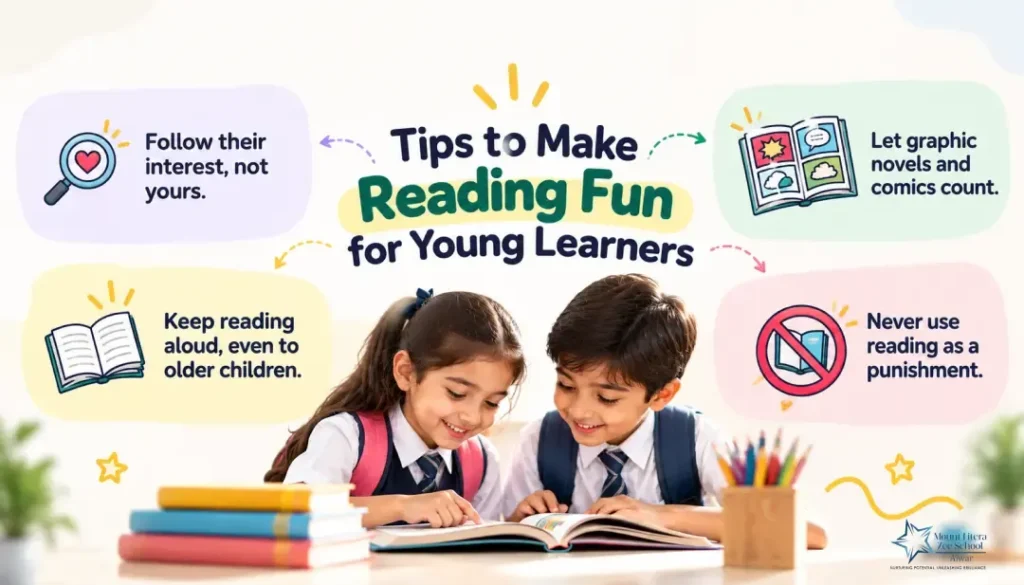
Almost every reluctant reader can be won over with the right book and no pressure.
- Follow their interest, not yours. A football-mad nine-year-old may ignore storybooks but devour a book about footballers.
- Let graphic novels and comics count. They carry real vocabulary and story, and they rebuild confidence in a child who finds dense text tiring.
- Keep reading aloud, even to older children. Hearing a gripping story makes a child want to find out what happens next for themselves.
- Never use reading as a punishment, and avoid testing them after every page. The moment reading feels like an exam, the habit stalls.
If a child struggles far more than peers of the same age with letters or sounds, mention it to their class teacher — early support makes a big difference.
How Mount Litera Zee School, Alwar helps your child read
A strong reading habit grows fastest when home and school pull in the same direction. At Mount Litera Zee School, Alwar, reading is treated as part of a child’s wider growth, not a one-off activity.
The school library gives children regular access to a changing range of age-appropriate books, so there is always something new to pick up. In class, reading is woven into project work and discussion rather than limited to the language period.
Reading also feeds directly into the school’s life-skills focus — building vocabulary, focus and the confidence to question ideas. You can read more about this in the school’s life skills and development programme, which places the child’s own thinking at the centre of learning.
Final thoughts
Building a reading habit in children aged 5 to 10 is less about rules and more about small, steady choices. Read with your child every day — a calm 15 minutes beats the occasional long session — and match your support to their age: read to 5–6s, take turns with 7–8s, and let 9–10s read on their own.
Keep books within easy reach, let your child choose what they enjoy, and use the library to keep fresh titles coming. Let them read in whichever language they are most comfortable in, since the habit carries across languages. And if your child resists reading, change the book rather than the child, and keep all the pressure out of it — the aim is a reader who comes back to books because they want to.
Frequently Asked Questions
1 At what age should a child start building a reading habit?
You can start reading aloud from the earliest years. Between ages 5 and 6, read to your child daily; by 7 to 8, take turns reading; and by 9 to 10, let them read on their own and talk about it together.
2 How much should a child aged 5 to 10 read every day?
About 10 minutes a day for a 5-to-6-year-old and 15 to 20 minutes for older children is enough. A short daily session they enjoy works far better than an occasional long one.
3 What should I do if my child does not like reading?
Change the book, not the child. Follow their interests, allow comics and graphic novels, keep reading aloud to them, and never use reading as a punishment or test.
4 Should my child read in English or their mother tongue?
Start with whichever language your child reads most happily. A child who enjoys stories in their mother tongue builds a habit that later carries over to English.
Written by
Rajan Jhiriwal
Mount Litera Zee School, Alwar — sharing guidance for parents and students.