

Why Project-Based Learning Matters for School Students
On this page
Project-based learning matters because it turns children from passive listeners into active problem-solvers. Instead of memorising facts for a test and forgetting them a week later, students learn by building, investigating, and creating so the knowledge stays with them. For parents in Alwar looking at how a school teaches, not just what it teaches, project-based learning (PBL) is one of the clearest signs that a school is preparing children for real life, not only for exams.
This guide explains what project-based learning is, why it matters more than ever, how it differs from traditional learning, whether it affects marks, and how you can support it at home.
What Is Project-Based Learning?
Project-based learning is a teaching method where students learn by working on a real, meaningful project over days or weeks, instead of absorbing information in isolated lessons. Rather than only reading about water conservation, for example, children might design a small rainwater-harvesting model, test it, and present what they found.
The project becomes the vehicle for learning. Along the way, students pick up subject knowledge science, maths, language but also research, teamwork and communication. The question shifts from “What is the right answer?” to “How do we solve this?” That shift is what makes the learning stick.
Why Project-Based Learning Matters More Than Ever
Rote learning can help a child clear an exam, but it rarely builds understanding that lasts. Here is why PBL makes a deeper difference.
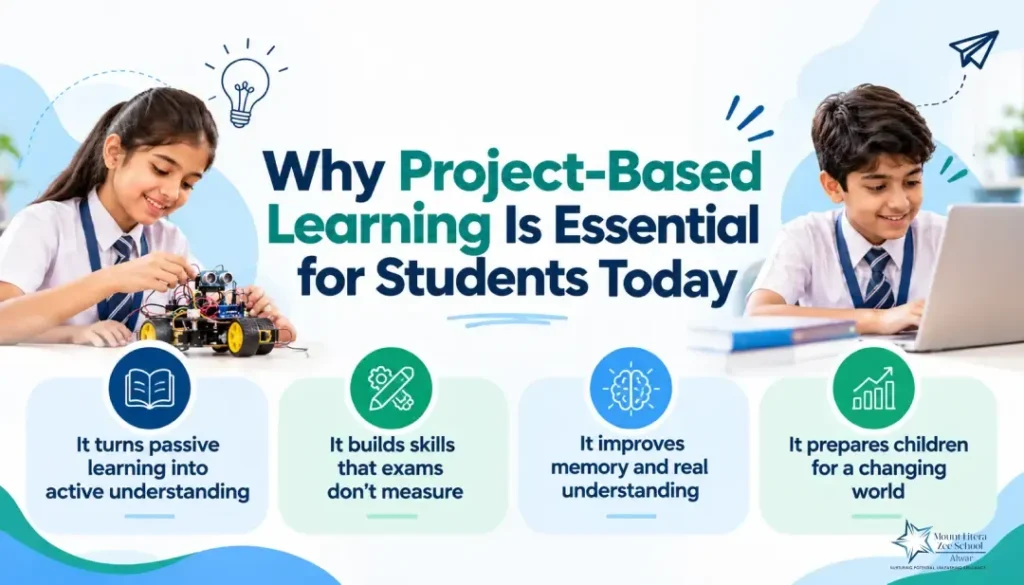
It turns passive learning into active understanding
When children do something with what they learn, understanding deepens. Building, experimenting and explaining force a student to truly grasp a concept, not just recognise it on a page. Active learning stays with a child far longer than passive reading ever does.
It builds skills that exams don’t measure
Collaboration, critical thinking, time management and the confidence to present ideas are abilities children carry into every stage of life. These are the same life skills that colleges and employers increasingly value and projects are one of the most natural ways to develop them.
It improves memory and real understanding
A fact learned through a hands-on project is tied to an experience, which makes it far easier to recall. A child who has actually built a working circuit remembers how it works long after the lesson ends, something a diagram alone rarely achieves.
It prepares children for a changing world
The careers today’s students will enter reward people who can think independently, adapt and solve unfamiliar problems. Project-based learning rehearses exactly these abilities from an early age, giving children a head start that memorisation alone cannot provide.
Project-Based Learning vs Traditional Learning
Both approaches have a place, but they build different strengths. A simple comparison:
| Aspect | Traditional Learning | Project-Based Learning |
| Child’s role | Listens and memorises | Investigates and creates |
| Main focus | The correct answer | The process of solving |
| Skills built | Recall | Thinking, teamwork, communication |
| Retention | Often short-term | Longer, tied to experience |
| Motivation | Driven by exams | Driven by curiosity |
The best CBSE school in Alwar does not choose one over the other. They blend strong fundamentals with regular project work, so children gain both solid knowledge and the ability to use it.
What Project-Based Learning Looks Like in a CBSE Classroom
PBL is not limited to a yearly science fair. In a well-run CBSE curriculum, it shows up across subjects:
- Science: designing a simple water-filtration model and testing which materials clean water best.
- Social studies: building a local history project by interviewing elders about how Alwar has changed over time.
- Maths: planning a mock budget for a class event, applying real calculations and choices.
- Language: writing, illustrating and presenting an original storybook to classmates.
These projects come alive in well-equipped science and computer labs and through structured programmes that build skills alongside academics, such as a school’s life and development framework.
How Parents Can Support Project-Based Learning at Home
You do not need special equipment to encourage this kind of learning. A few simple habits help:
- Ask “how” and “why” questions instead of only checking whether homework is done.
- Let children solve small real problems — planning a weekend outing, measuring ingredients while cooking, or fixing a simple task at home.
- Encourage curiosity over perfection. A messy first attempt that teaches something beats a tidy answer copied from a book.
- Pair projects with reading. A strong reading habit gives children the vocabulary and ideas to explore projects more deeply.
Small, consistent encouragement at home reinforces what a good school builds in the classroom.
What to Look for in Your Child’s School
A visit is your best chance to see how learning really happens, so look beyond the building and the brochure. A few focused questions reveal how seriously a school takes hands-on learning:
- How often do children work on real projects, and in which subjects?
- Are the science, computer and activity labs used regularly — or only shown to visitors?
- How do teachers assess learning beyond written exams, such as through presentations, models or portfolios?
- Can the school show you actual student projects, not just talk about them?
- Does the timetable leave room for activities, labs and group work alongside academics?
A school that can show you genuine student work has built project-based learning into its teaching, rather than bolting it on for a tour. Watch the children too: are they curious and involved, or simply sitting quietly? That tells you more than any presentation.
This is exactly the kind of learning Mount Litera Zee School, Alwar is built around. Hands-on projects, well-equipped labs and activity-rich classrooms are part of everyday teaching, not a special event — so children learn to question, build and present, and understand concepts instead of just memorising them. When you visit, ask to see this in action.

Conclusion
Project-based learning is not a passing trend — it is how children learn to think, not just to remember. By pairing strong academics with real, hands-on projects, a good school helps your child build understanding, curiosity and the confidence to solve problems on their own. When you choose a school in Alwar, look for one that treats learning as something children do, not just something they are told. That single choice shapes not only their marks, but the way they will approach learning for the rest of their lives.
Frequently Asked Questions
1 What is project-based learning in simple terms?
It is a way of learning where children gain knowledge and skills by working on a real project like building a model or solving a problem instead of only memorising from a book.
2 Is project-based learning better than traditional learning?
Neither is “better” on its own. Traditional learning builds strong fundamentals; project-based learning builds understanding and skills. The best schools blend both.
3 Does project-based learning help with exams?
Yes. When a child understands a topic through a project, the learning is genuine and usually leads to better recall and exam performance on that topic.
4 How can parents support project-based learning at home?
Ask “how” and “why” questions, let children solve small real-life problems, encourage curiosity over perfect answers, and pair projects with regular reading.
Written by
MLZS Alwar
Mount Litera Zee School, Alwar — sharing guidance for parents and students.

